The Context Gap in eDiscovery
Context Gap (eDiscovery): The structural difference between collaborative cloud evidence behavior and the final-state file exports typically produced by traditional eDiscovery systems.
Definition
The Context Gap in eDiscovery refers to the structural difference between:
- How evidence is created in collaborative cloud platforms, and
- What traditional eDiscovery systems can reconstruct after the fact.
Modern collaboration environments (such as Microsoft 365, Google Workspace, and Slack) generate evidence through hyperlinks, shared repositories, version histories, and evolving identity states.
Traditional eDiscovery workflows typically export final-state files and messages, losing the contextual signals required to reproduce what actually occurred.
This gap creates a situation where the preserved evidence cannot deterministically answer questions about:
- which document version existed at the time of communication
- who had access at a given moment
- what version informed a decision
- what interactions actually occurred.
Reconstruction-Grade eDiscovery addresses the Context Gap through evidence reconstruction — preserving context as first-class evidence.
How the Context Gap Manifests
The Context Gap is not a single failure. It is a pattern of structural mismatches between what collaborative platforms produce and what legacy evidence models expect.
Figure — The Context Gap
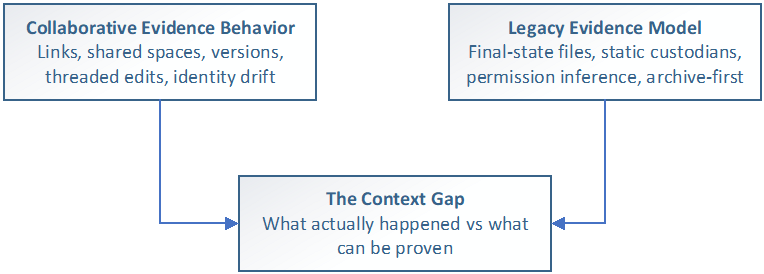
Legacy assumptions vs collaborative reality
| Evidence Dimension | Legacy Assumption | Collaborative Reality |
|---|---|---|
| Unit of evidence | File or attachment | Activity + link + shared repository object |
| Evidence capture | Final-state collection | Point-in-time resolution per event |
| Custodians | Static containers | Natural persons with effective-dated identity |
| Access | Inferred from permissions | Observed via audit evidence where available |
| Versioning | Minor or ignored | Continuous; version lineage is evidentiary |
| Messages | Immutable email | Threaded, editable, multi-modal conversations |
When evidence systems collect only today's file state, they produce a time-shifted record. The exported bytes are not the bytes that informed a decision at the time.
What the gap looks like in practice
- A Teams message links to a OneDrive document. The file is edited after the message is sent. A traditional export collects the current file bytes—not the version that informed the decision.
- A custodian changes roles mid-matter. The exported identity reflects who they are today, not who they were during the relevant period.
- Permissions say a person could have accessed a file. But there is no audit evidence showing they did.
- Audit logs age out of retention. The behavioral evidence needed to answer "who saw what, when" no longer exists.
These are not edge cases. They are the default behavior of collaborative cloud platforms.
Related Concepts
The Context Gap is closely related to several structural challenges in modern eDiscovery:
-
Modern Attachments / Hyperlinked Files — Messages reference live repository objects via hyperlinks instead of embedding file bytes. The message does not carry the document state it references.
-
Version Lineage Evidence — Files are continuously revised. Version lineage is the audit trail of authorship, evolution, and reliance. Ignoring version history means ignoring the evidentiary record.
-
Identity Drift — People change roles, teams, access rights, and reporting lines. Legal questions are temporal, but directory snapshots are not.
-
Permission vs Observed Access — Permissions describe potential access. Audit logs record observed behavior. Substituting one for the other is inference, not evidence.
-
Reproducible Evidence Exports — An export where the same scope definition and parameters produce the same outputs, with manifests, hashes, and exception traceability.
-
Context Collapse — The flattening of collaborative evidence into disconnected files and messages, making reconstruction dependent on inference rather than preserved fact.
How Reconstruction-Grade eDiscovery Addresses the Context Gap
The Reconstruction-Grade eDiscovery Standard (RGR) was created specifically to close the Context Gap. It defines measurable, testable criteria for evidence systems that preserve context as first-class evidence across three pillars:
-
Identity over time — Effective-dated identity correlated to a natural person, including role, department, manager, status, and group membership as of any historical date.
-
Behavior and activity evidence — Audit and activity records treated as first-class evidence to establish interaction and timing, explicitly bounded by upstream availability, licensing, and retention.
-
Document state and relationships — Deterministic point-in-time file resolution using stable platform-native identifiers. Explicit message ↔ link ↔ file ↔ version bindings preserved so that every communication can be reconnected to the document state it referenced.
These three pillars are formally defined in Section 3: Defining Reconstruction-Grade eDiscovery.
The standard does not treat inference as defensibility. When context cannot be grounded in preserved fact, it is represented as unknown—not assumed.
Further Reading
- What Is Reconstruction-Grade eDiscovery? — Full definition of the architectural classification
- What Is Evidence Reconstruction? — The capability that closes the Context Gap
- Modern Attachments — How hyperlinked files drive the Context Gap
- Identity Drift — How changing custodian identity creates temporal evidence gaps
- Section 1: The Structural Shift in Evidence Behavior — The evidence model changes that created the Context Gap
- Section 2: The Context Collapse Problem — Failure modes that result from the Context Gap
- Section 3: Defining Reconstruction-Grade eDiscovery — The evidence model that closes the gap
- Appendix A: Glossary — Key terms used throughout the standard
About this standard. The Reconstruction-Grade eDiscovery Standard is an open, vendor-neutral specification maintained at github.com/cloudficient/reconstruction-grade-ediscovery-standard and licensed under CC BY 4.0.
Read the full standard: Reconstruction-Grade eDiscovery Standard →